

Is worry the background noise of motherhood?

Understanding perinatal mood disorders, anxiety, and the thoughts new mothers are afraid to say out loud.
News surrounding the Lindsey Clancy case has brought perinatal mood disorders and postpartum mental illness to the forefront of many of our minds. Seeing postpartum mental illness discussed so publicly may bring up difficult questions, uncomfortable thoughts, and for some, even a sense of recognition, especially if it’s the first time they’ve ever seen experiences that feel familiar to them reflected and in public discourse and media. Both good and bad can come from these conversations. While recognition is important, along with it comes judgement, one of the biggest barriers to seeking help. Those needing help may find themselves asking:
What if they think I’m a bad mom?
What if they think I’m dangerous?
What if they think I can’t handle my baby and they take them away?
The truth is that postpartum mental illness exists on a spectrum, and struggling with your mental health does not make you a bad, or ill-equipped parent. Understanding perinatal mood disorders begins with understanding this spectrum.
Perinatal Mood Disorders
According to a 2024 Statistics Canada survey, 49% of Canadian new moms struggle with their mental health postpartum.
Perinatal period: Encompasses pregnancy and postpartum period (up to 1 year after giving birth).
Baby blues: Adjustment experience occurring within the first 2 weeks postpartum, new parents may feel tearful, overwhelmed, anxious and emotionally activated. Experienced by 50-90% of new parents.
Perinatal depression: Mood disorder that can develop during pregnancy or after childbirth, involving persistent sadness, hopelessness, loss of interest or pleasure, changes in sleep or appetite, low energy, guilt, or feeling disconnected from yourself or your baby.
Perinatal anxiety: Anxiety disorder that can develop during pregnancy or after childbirth, involving excessive or difficult-to-control worry, fear, restlessness, panic, physical symptoms of anxiety, or intrusive thoughts about something going wrong with you or your baby.
Perinatal OCD: A form of obsessive-compulsive disorder that can develop during pregnancy or after childbirth. Characterized by distressing, unwanted intrusive thoughts and compulsive behaviours such as checking or reassurance-seeking.
Perinatal PTSD: A form of post-traumatic stress disorder that can occur following a traumatic pregnancy, birth, or medical experience and may involve flashbacks, nightmares, or avoidance.
Postpartum psychosis: A rare but serious psychiatric emergency. Can involve confusion, hallucinations, delusions, or significant changes in behaviour.
Source: Content adapted from the Centre for Addiction and Mental Health (CAMH), Perinatal Mood and Anxiety Disorders: Diagnosis.
When worry turns into anxiety
Worry is a normal part of becoming a new parent. Normal new parent worries look like passing concerns, or thoughts that fade after you check on your baby or find a solution. When worry begins to transition into anxiety, it’s important that we look primarily at what this worry is doing to your life. Anxiety becomes all-consuming, your mind is filled with worst-case scenarios that do not go away after checking on the baby or finding a solution. You might find yourself completely exhausted, but unable to sleep due to hypervigilance. Maybe you feel an urge to control everything, not accepting help from others out of a place of intense fear. One passing thought becomes hours of Google searching, reading reddit threads, checking the baby monitor, asking for reassurance from others, and imagining every worst-case scenario possible.
Therapist Tip #1: Expanding your capacity to tolerate uncertainty.
When worries pop up, ask yourself: “Is this something I need to respond to right now, or is anxiety asking me to feel completely certain?”
Learning to tolerate uncertainty is a key step in managing anxiety.

The Anxiety Cycle
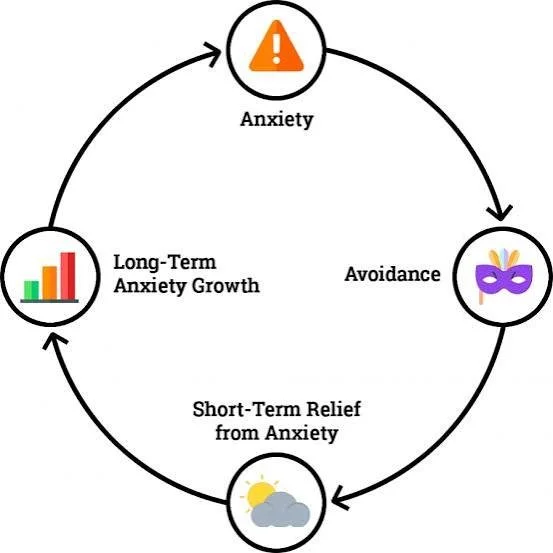
Anxiety is tricky. The things it makes us do in order to mitigate it, actually more often than not reinforce it. The anxiety cycle looks something like this:
Worry or anxiety arises → Safety-seeking behaviour (checking, reassurance-seeking, avoidance) → Temporary relief from anxiety → More worry → Increased (long-term) anxiety
Let’s take a look at what this looks like with a common postpartum worry:
WORRY
“Is my baby breathing normally?”
REASSURANCE-SEEKING
You check your baby’s breathing to make sure they’re okay.
TEMPORARY RELIEF
“Okay, they’re breathing. Everything is fine.”
WORRY RETURNS
“But what if something changes?”
INCREASED ANXIETY
The uncertainty feels difficult to tolerate.
REASSURANCE-SEEKING
You check your baby’s breathing once more.
TEMPORARY RELIEF
You feel better (for now).
THE CYCLE REPEATS
The worry returns, and the urge to check becomes stronger.
Eventually your brain learns that, rather than the baby simply being safe, checking is what keeps your baby safe.
Anxiety doesn’t say “Okay, you’ve checked enough.” Anxiety says “Okay, let’s just check one more time.” The point here isn’t to never check on your baby. The point is to notice when checking becomes a way of getting rid of anxiety, rather than a legitimate concern.
The Thoughts We’re Afraid to Say Out Loud:
What if I drop my baby?
What if I hurt them?
What if I don’t wake up when they cry?
What if I don’t love being a mom?
What if something happens while I’m driving?
Why am I not bonding with my baby?
What kind of mother feels this way about their child?
Short answer: An anxious one!
Intrusive thoughts tend to be so distressing because they are not consistent with your values. The more inconsistent or frightening a thought may be, the more likely you are to want to spend time pushing it away, seeking reassurance, or trying to prove that this thought means nothing. But thoughts are not facts, they’re just thoughts. You do not have to solve every thought produced by your brain. And the more we try to solve them, the more powerful they may become.
Therapist Tip #2: Dealing with intrusive thoughts.
Instead of asking why you thought this or what it means, try saying “That’s an uncomfortable thought. I don’t need to solve it right now.”
Getting Support
You can be an anxious mother and still be a wonderful mother. You can experience a perinatal mood or anxiety disorder, and still be the best parent to your child. Discussing postpartum mental health can come along with an enormous amount of shame, but asking for help is not an admission that you can’t handle being a parent. Support might look like leaning on trusted people for practical help, using grounding strategies when anxiety spikes, finding small ways to shift your focus, or working with a doctor, therapist or other licensed mental health professional.
If you've been experiencing persistent worry, intrusive thoughts, constant checking, or feeling like your brain is always preparing for something to go wrong, you don't have to navigate it alone. This fall, I'll be offering a Postpartum Anxiety Support Group for mothers looking for support, connection, and practical tools for managing anxiety during the postpartum period.
Join the waitlist here.
If you are experiencing thoughts of harming yourself or your baby, feel disconnected from reality, or are experiencing hallucinations, delusions, severe confusion, or feel that you or someone else may be in immediate danger, seek urgent support. In Canada, you can call or text 9-8-8 for crisis support, call 911, or go to your nearest emergency department; you can also contact your healthcare provider, midwife, or obstetrician for urgent guidance.
